Professional football places trained observers in the press box with authority to stop the game. The design solves a specific problem: nobody on the field is well placed to notice a head injury.
Why the sideline is a bad vantage point
Sideline medical staff watch from field level through a crowd of players, officials and equipment. Their view of any single collision is partial at best.
They are also busy. During live play the staff is treating other athletes, and the moments after a snap are the ones in which a subtle injury shows.
An athlete who is briefly unsteady and then jogs back to the huddle may never be noticed from that angle. The window in which the sign appears is very short.
What the booth adds
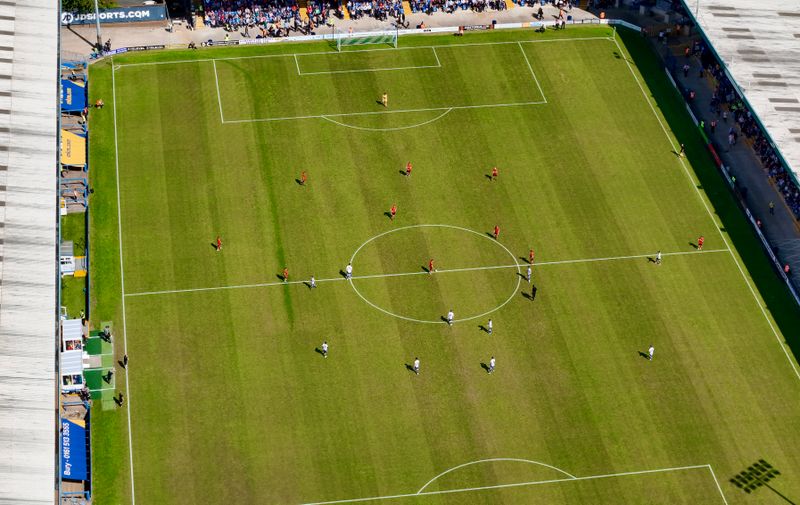
An observer in the booth has elevation, a full view of the field, and access to replay. They can watch a collision again immediately and in slow motion.
Certain visible signs are treated as triggers rather than judgment calls, including unsteadiness on standing, a blank or vacant look, and any loss of responsiveness however brief.
Seeing the mechanism repeatedly matters because the sign is often clearer on replay than live. A stumble that read as a trip in real time reads differently at reduced speed.
The authority to stop play
Observation without power to act would change nothing. These roles carry the ability to halt the game so the athlete can be evaluated, without a team's agreement.
That is a meaningful intrusion into a game clock, and it exists because the alternative failed. Teams relying on their own staff and their own athletes produced systematically low detection.
The independence is the point. An observer who is not employed by either club has no stake in whether a starting quarterback stays in the game.
Why athletes cannot be relied on to self-report
Concussion symptoms are largely invisible and largely self-reported, which places the burden on the person whose judgment the injury has just impaired.
Incentives push the other way as well. Roster position, playing time and contract status all argue for staying on the field, and athletes weigh those in the moment.
An external trigger removes the athlete's decision from the process at the point where their decision is least reliable. That is the mechanism the booth is enforcing.
Limits of the system
Visible signs catch only a portion of concussions. Many produce no observable moment at all, and a normal-looking play can still result in an injury.
Camera coverage also has gaps. Away from the ball, in a pile, or with the broadcast following a different player, the mechanism may simply not be recorded.
Which is why the booth is described as an additional layer rather than a screen. It raises detection without turning it into something the game can be trusted to catch every time.